
PSH HAD (Vietnam)
A 600 MW pumped-storage plant featuring 3 turbine pumps, Gross head: 540 m, and 4 000 MWh of daily storage (6.7h generation / 9.2h pumping)
General description
- Pumped-storage hydropower plant between an existing downstream reservoir and an upstream reservoir to be constructed.
- Capacity of 600 MW, with 4,000 MWh of daily storage (6.7 hours of generation, 9 hours of pumping).
- Existing downstream reservoir with a surface area of 826 km² and a capacity of 226 million m³. Mainly used for irrigation and secondarily for hydropower generation. The owner of the reservoir is DARD (Department of Agriculture & Rural Development).
- Upstream reservoir: Dam to be constructed. Capacity of 3.15 million m³, i.e. 1.4% of the downstream reservoir. Study of an alternative option with a pond instead of a dam, reducing risks and the impacted area.
- Implementation from upstream reservoir to downstream reservoir: 1.6 km underground tunnel, underground powerhouse and 400 m underground tailrace tunnel.
- Connection Point : 500 kV substation (COD in 2029), 30 km away.
General data
- Capacity: 600 MW
- Machines: 3x Turbine Pump
- Average Head: 540 m
- Turbine flow: 132 m³/s
- Pump flow: 96 m³/s
- Turbine hours: 6.6 h daily
- Pump hours: 9.2 h daily
- Waterway length: 1800m
- Lower lake: Existing Reservoir
- Lower lake vol.: 210 M m³
- Upper lake: Dam to be built
- Upper lake vol.: 3.1 M m³
Existing Reservoir
- Reservoir tot. capacity: 226 M m³
- Reservoir tot. capacity: 226 M m³
- MNDBT: 91,9 m asl
- Minimum water level: 65 m asl
- Surface (MNDBT): 826 km²
Operating Principle
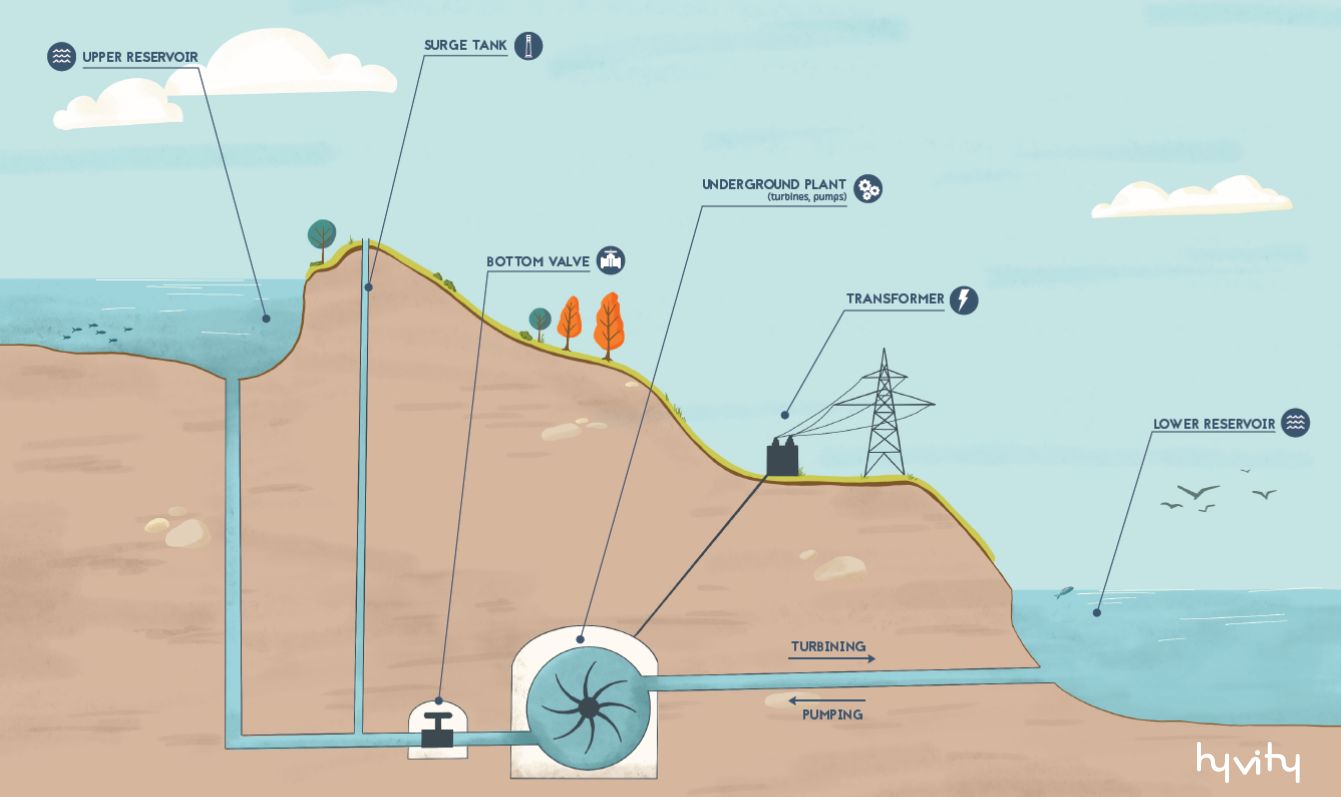
The principle of a Pumped Hydro Storage (PHS) involves transferring water between two reservoirs located at different altitudes, by exploiting the potential energy of water. During periods of low electricity demand, the surplus energy, which would otherwise be lost (often from inevitable renewable sources like solar or wind), is used to pump water from the lower reservoir to the upper reservoir.
When the demand for electricity increases and other energy production sources are no longer sufficient to meet the demand, water is released from the upper reservoir to the lower reservoir, passing through turbines that generate electricity.
There are several types of PHS: pure closed-loop PHS, mixed PHS fueled by a river, and marine PHS that use seawater.
The advantages of PHS
Sustainability, flexibility, and responsiveness
This mature technology, dating back to the early 20th century, has long been reliable with low maintenance needs. Pumped Hydro Storage (PHS) boasts a lifespan exceeding 70 years, unparalleled compared to other existing storage technologies.
Stabilization of the electrical grid
For all states that have them, Pumped Hydro Storage (PHS) is synonymous with energy sovereignty. Indeed, they help reduce reliance on fossil fuels to stabilize electricity transmission networks. They also play an important role in regulating electricity prices.
Numerous economic advantages
For all states that have them, Pumped Hydro Storage (PHS) is synonymous with energy sovereignty. Indeed, they help reduce reliance on fossil fuels to stabilize electricity transmission networks. They also play an important role in regulating electricity prices.
Pumped Hydro Storage (PHS) is currently the only technology mature and economically viable for massive electrical energy storage. The increasing demand, coupled with the desire to reduce fossil fuel sources and the massive deployment of solar and wind energy, make it an essential component of our future energy landscape.
Hyvity’s choice, in order to reduce the environmental impact of its PHS projects, focuses on the development of small and medium-scale facilities (between 10 to 600 MW), preferably utilizing existing reservoirs.